Glpn Kitti
Global-Local Path Networks (GLPN) model trained on KITTI for monocular depth estimation. It was introduced in the paper Global-Local Path Networks for Monocular Depth Estimation with Vertical CutDepth by Kim et al....
Modellquelle
- Art
- Other
- Dateigröße
- 234 MB
- Version
- vRevision e9e8485
- Aktualisiert
- 8. Okt. 2026
- Downloads
- 16.012
- Quelle
- Hugging Face
Quellenbeschreibung
GLPN fine-tuned on KITTI
Global-Local Path Networks (GLPN) model trained on KITTI for monocular depth estimation. It was introduced in the paper Global-Local Path Networks for Monocular Depth Estimation with Vertical CutDepth by Kim et al. and first released in this repository.
Disclaimer: The team releasing GLPN did not write a model card for this model so this model card has been written by the Hugging Face team.
Model description
GLPN uses SegFormer as backbone and adds a lightweight head on top for depth estimation.
model image
Intended uses & limitations
You can use the raw model for monocular depth estimation. See the model hub to look for fine-tuned versions on a task that interests you.
How to use
Here is how to use this model:
from transformers import GLPNImageProcessor, GLPNForDepthEstimation
import torch
import numpy as np
from PIL import Image
import requests

url = "http://images.cocodataset.org/val2017/000000039769.jpg"
image = Image.open(requests.get(url, stream=True).raw)

processor = GLPNImageProcessor.from_pretrained("vinvino02/glpn-kitti")
model = GLPNForDepthEstimation.from_pretrained("vinvino02/glpn-kitti")

# prepare image for the model
inputs = processor(images=image, return_tensors="pt")

with torch.no_grad():
    outputs = model(**inputs)
    predicted_depth = outputs.predicted_depth

# interpolate to original size
prediction = torch.nn.functional.interpolate(
    predicted_depth.unsqueeze(1),
    size=image.size[::-1],
    mode="bicubic",
    align_corners=False,
)

# visualize the prediction
output = prediction.squeeze().cpu().numpy()
formatted = (output * 255 / np.max(output)).astype("uint8")
depth = Image.fromarray(formatted)
For more code examples, we refer to the documentation.
BibTeX entry and citation info
@article{DBLP:journals/corr/abs-2201-07436,
  author    = {Doyeon Kim and
               Woonghyun Ga and
               Pyunghwan Ahn and
               Donggyu Joo and
               Sehwan Chun and
               Junmo Kim},
  title     = {Global-Local Path Networks for Monocular Depth Estimation with Vertical
               CutDepth},
  journal   = {CoRR},
  volume    = {abs/2201.07436},
  year      = {2022},
  url       = {https://arxiv.org/abs/2201.07436},
  eprinttype = {arXiv},
  eprint    = {2201.07436},
  timestamp = {Fri, 21 Jan 2022 13:57:15 +0100},
  biburl    = {https://dblp.org/rec/journals/corr/abs-2201-07436.bib},
  bibsource = {dblp computer science bibliography, https://dblp.org}
}
Quellen
1 Quelle
Quellen
1 QuelleVerifiziert 25. Aug.
Modellartefakte
1 Artefakt
Modellartefakte
1 ArtefaktQuellenauszüge
2 Auszüge
Quellenauszüge
2 Auszüge--- license: apache-2.0 tags: - vision - depth-estimation widget: - src: https://huggingface.co/datasets/mishig/sample_images/resolve/main/tiger.jpg example_title: Tiger - src: https://huggingface.co/datasets/mishig/sample_images/resolve/main/teapot.jpg example_title: Teapot - src: https://huggingface.co/datasets/mishig/sample_images/resolve/main/palace.jpg example_title: Palace --- # GLPN fine-tuned on KITTI Global-Local Path Networks (GLPN) model trained on KITTI for monocular depth estimation. It was introduced in the paper [Global-Local Path Networks for Monocular Depth Estimation with Vertical CutDepth](https://arxiv.org/abs/2201.07436) by Kim et al. and first released in [this repository](https://github.com/vinvino02/GLPDepth). Disclaimer: The team releasing GLPN did not write a model card for this model so this model card has been written by the Hugging Face team. ## Model description GLPN uses SegFormer as backbone and adds a lightweight head on top for depth estimation. 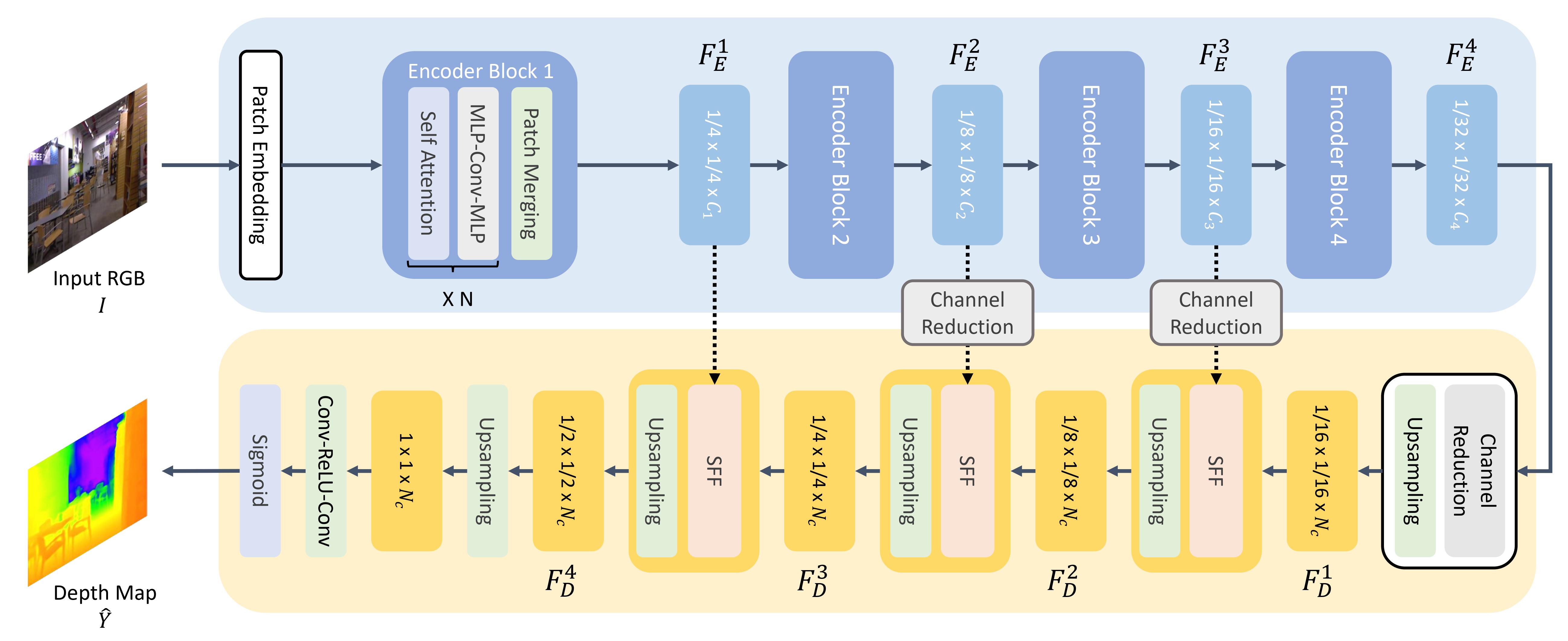 ## Intended uses & limitations You can use the raw model for monocular depth estimation. See the [model hub](https://huggingface.co/models?search=glpn) to look for fine-tuned versions on a task that interests you. ### How to use Here is how to use this model: ```python from transformers import GLPNImageProcessor, GLPNForDepthEstimation import torch import numpy as np from PIL import Image import requests url = "http://images.cocodataset.org/val2017/000000039769.jpg" image = Image.open(requests.get(url, stream=True).raw) processor = GLPNImageProcessor.from_pretrained("vinvino02/glpn-kitti") model = GLPNForDepthEstimation.from_pretrained("vinvino02/glpn-kitti") # prepare image for the model inputs = processor(images=image, return_tensors="pt") with torch.no_grad(): outputs = model(**inputs) predicted_depth = outputs.predicted_depth # interpolate to original size prediction = torch.nn.functional.interpolate( predicted_depth.unsqueeze(1), size=image.size[::-1], mode="bicubic", align_corners=False, ) # visualize the prediction output = prediction.squeeze().cpu().numpy() formatted = (output * 255 / np.max(output)).astype("uint8") depth = Image.fromarray(formatted) ``` For more code examples, we refer to the [documentation](https://huggingface.co/...
Source context: 16012 downloads · 10 likes · Pipeline depth-estimation · Library transformers · Repo vinvino02/glpn-kitti